Best Crown for Front Tooth: What to Choose

If you chip a front tooth, finish a root canal, or notice an old crown starting to darken at the edge, the question becomes very personal very quickly: what is the best crown for front tooth restoration? For most people, this is not just about fixing damage. It is about speaking, smiling, and feeling like themselves again without worrying that the tooth looks too opaque, too bulky, or slightly off next to the natural teeth.
The honest answer is that the best choice depends on two things happening at once: the crown needs to look beautifully natural, and it needs to hold up under real daily function. Front teeth do not carry the same chewing forces as molars, but they are under constant visual scrutiny. That changes how a dentist plans treatment.
What makes the best crown for front tooth cases?
A front tooth crown sits in the most visible part of your smile, so small details matter more than patients often expect. Shape, translucency, surface texture, light reflection, and gumline harmony all affect whether the crown blends in or stands out.
Strength still matters, but with front teeth, esthetics often lead the conversation. A very strong material that looks flat or artificial may not be the best fit for a patient who wants a natural, refined smile. On the other hand, the most lifelike material is not automatically the right answer if the tooth has limited support, heavy bite pressure, or a history of chipping.
That is why good crown planning is rarely about picking a material from a menu. It is about matching the material to the tooth, the bite, and the patient’s expectations.
The main crown materials for front teeth
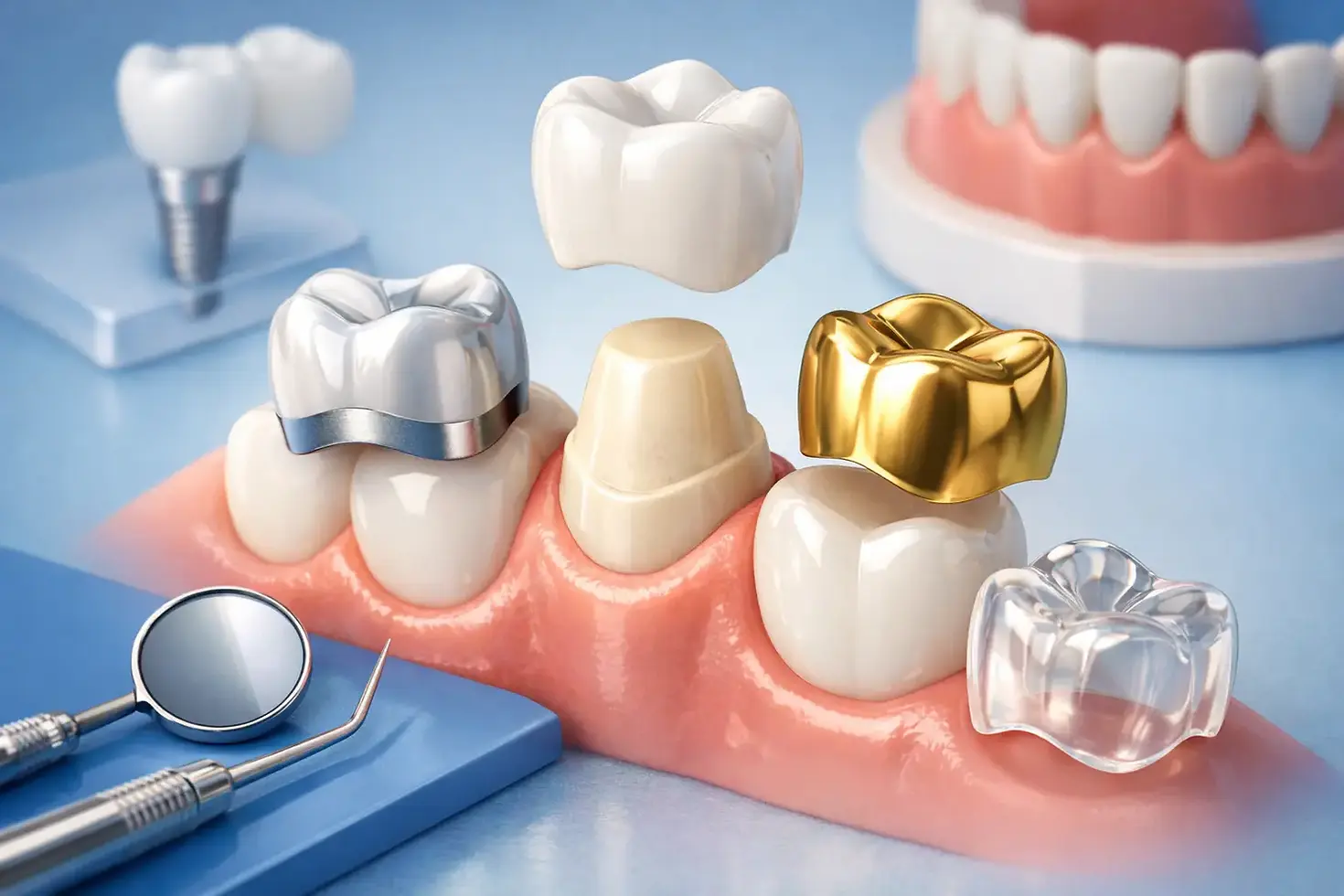
All-ceramic crowns
For many patients, all-ceramic crowns are the leading choice for front teeth because they offer excellent esthetics. They can mimic the subtle translucency and brightness of natural enamel more convincingly than older metal-based options.
This category includes several ceramic types, but the appeal is similar: no dark metal underneath, no gray shadow near the gumline, and a more natural interaction with light. If your priority is a crown that disappears into your smile, all-ceramic is often where the conversation starts.
The trade-off is that not every ceramic behaves the same way. Some are more beautiful but slightly less strong, while others are stronger but a little less translucent. This is where customized treatment planning matters.
Zirconia crowns
Zirconia has become very popular because it is strong, durable, and increasingly esthetic. Newer generations of zirconia look far better than older versions, especially when designed carefully for front teeth.
For a patient who clenches, has a heavier bite, or needs more durability, zirconia may be an excellent option. The caution is that not all zirconia crowns have the same lifelike quality. In highly visible front tooth cases, the dentist and lab need to manage shade, contour, and surface character very precisely so the result does not look too solid or uniform.
Porcelain-fused-to-metal crowns
Porcelain-fused-to-metal crowns were once a very common solution. They combine a metal substructure with porcelain layered on top. They can still function well, but for front teeth, they are often less ideal from a cosmetic standpoint.
The reason is simple. Over time, some patients notice a dark line near the gumline or a less natural appearance when light hits the crown. If the gums recede, the metal edge can become more noticeable. For back teeth or certain specific cases, these crowns may still have a place, but they are no longer the first choice for many appearance-focused front tooth restorations.
So what is the best crown for front tooth replacement?
In many modern cosmetic and restorative cases, the best crown for front tooth treatment is an all-ceramic crown, often made from high-quality porcelain or carefully selected esthetic zirconia. That said, there is no single winner for every patient.
If your front tooth is in the smile line and the surrounding teeth have natural translucency, a highly esthetic ceramic crown may offer the most convincing result. If you have a stronger bite, edge-to-edge contact, or parafunctional habits like clenching, zirconia may provide a better balance of beauty and resilience.
A skilled dentist will not only consider the crown material but also the underlying tooth condition. A front tooth that has had root canal treatment, a post, or significant structure loss may need a different strategy than a tooth with a small fracture and strong remaining enamel.
Why the material is only part of the result
Patients often focus on the crown material because it sounds like the biggest decision. In reality, the final appearance depends just as much on preparation design, digital scanning, shade selection, gum health, and lab craftsmanship.
A beautifully chosen ceramic can still look wrong if the tooth is overprepared, the crown is too thick, or the shade is selected in poor lighting. Likewise, an excellent lab technician can create a crown with subtle texture and translucency that looks far more natural than a generic, one-tone restoration.
This is where digital dentistry can make a meaningful difference. Intraoral scanning, high-resolution imaging, and careful smile planning help create a crown that fits more precisely and harmonizes better with the adjacent teeth. For patients investing in a visible restoration, precision is not a luxury. It is part of what makes the result believable.
When a front tooth crown may not be the only option
Sometimes patients ask for a crown when another treatment may be more conservative or more appropriate. If the front tooth has minor cosmetic issues, bonding or veneers may preserve more natural tooth structure. If the tooth is severely damaged below the gumline or has a poor long-term prognosis, extraction and implant planning may need to be discussed.
This matters because the best crown for front tooth concerns is only the best option if the tooth itself can support it predictably. A premium crown on a failing foundation is not truly a premium result.
Questions worth asking before you choose
Before moving ahead, patients should understand not just what material is being used, but why it is being recommended. A good consultation should explain how the crown will look next to the neighboring teeth, how durable it is expected to be, and whether there are any limitations based on bite or tooth condition.
It is also reasonable to ask whether the case will be digitally scanned, how shade matching is handled, and what the plan is if you are unhappy with the temporary appearance or shape. Front tooth work is personal. You should feel guided, not rushed.
For patients who are especially appearance-conscious, photos, mock-ups, or detailed discussions about tooth shape can be very reassuring. Small refinements make a big difference when the restoration is in the center of your smile.
How long does a front tooth crown last?
A well-made front tooth crown can last many years, often well over a decade, but longevity depends on the material, your bite, oral hygiene, and whether you grind your teeth. Even the best-looking crown needs healthy gums and regular maintenance.
Front crowns can fail from chipping, leakage at the margin, trauma, or changes in the surrounding teeth and gumline. That is why routine reviews matter. The goal is not just to place a crown that looks good on day one, but to support a result that continues to look balanced over time.
If you wear a night guard or need one, that can also influence longevity. Protecting a front crown from repeated grinding forces is often a simple step that preserves the investment.
Choosing the right dentist matters as much as choosing the right crown
When a restoration sits at the front of your smile, technical skill and esthetic judgment need to work together. This is not only about closing a gap or covering damage. It is about creating a tooth that feels like it belongs to you.
At a clinic that emphasizes advanced restorative and cosmetic planning, patients benefit from more than materials alone. They benefit from detailed imaging, precise design, and a treatment process built around comfort and confidence. That is the standard many patients are looking for when they compare options for a visible tooth.
If you are weighing the best crown for front tooth treatment, the most useful next step is a personalized evaluation. The right crown is the one that matches your smile, supports your bite, and restores confidence without looking like dental work at all.
A front tooth crown should not simply repair what was lost. It should let you smile without a second thought.


Comments