Full Dentures Versus Implants: Which Fits?

Losing most or all of your teeth changes more than your smile. It changes how confidently you eat in public, how clearly you speak, and how comfortable you feel in your own skin. When patients start comparing full dentures versus implants, they are usually not just asking about teeth. They are asking what daily life will feel like after treatment.
That is the right question to ask, because both options can restore your smile, but they do it in very different ways. One may be the better fit for your budget right now. The other may be the better fit for your long-term comfort, function, and confidence. The best choice depends on your bone support, health, expectations, and how much stability matters to you.
Full dentures versus implants: the core difference
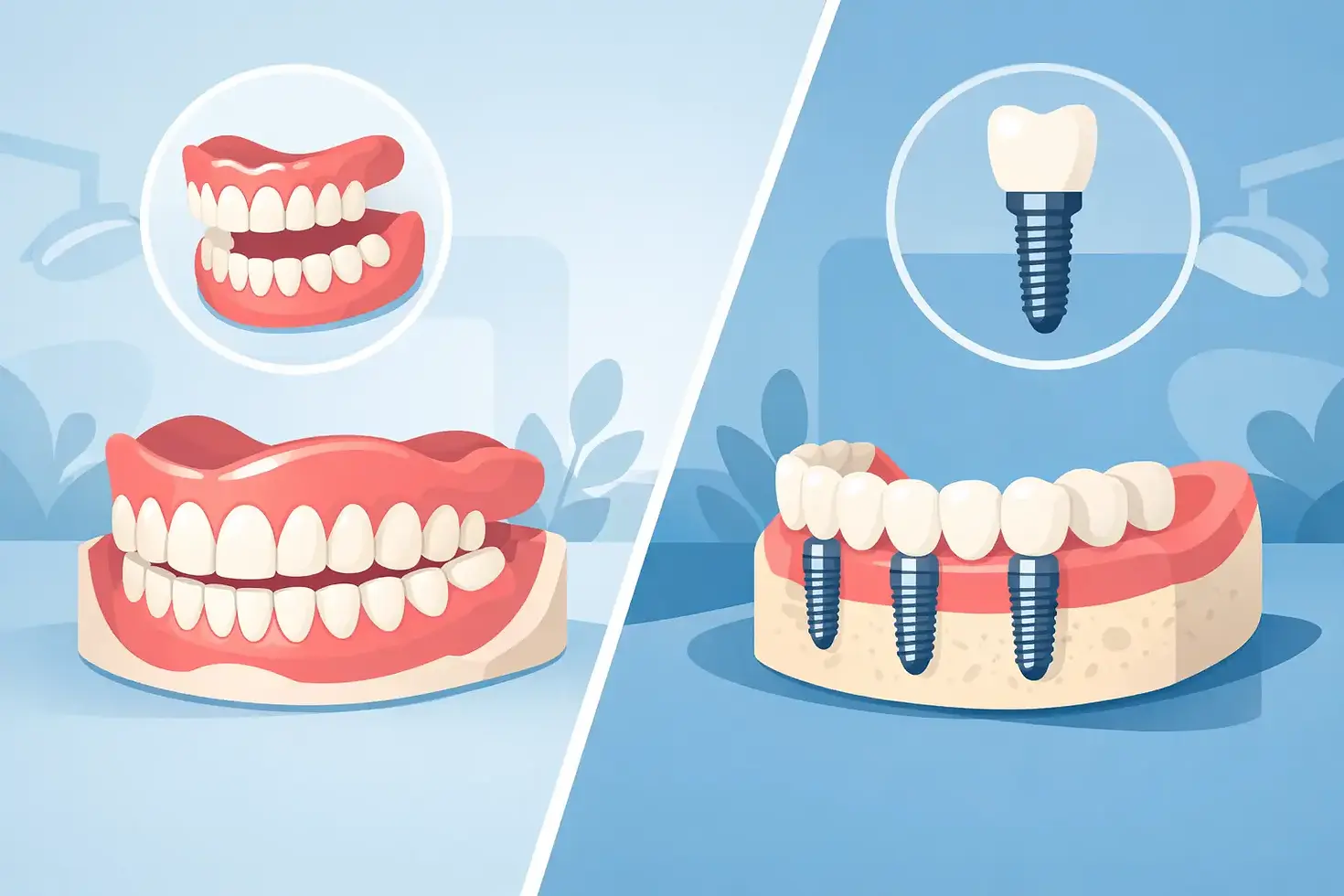
Full dentures are removable prosthetic teeth that sit on top of the gums. They replace an entire upper arch, lower arch, or both. Traditional dentures rely on the shape of your gums and jaw for support, and in some cases denture adhesive is used to improve hold.
Dental implants work differently. Small titanium posts are placed into the jawbone to act like artificial tooth roots. Those implants can then support a full arch of fixed teeth or help secure a removable denture. That difference matters because implants do not simply replace visible teeth. They also replace some of the lost support that natural tooth roots once provided.
For many patients, the real comparison is not just removable versus fixed. It is tissue-supported teeth versus bone-supported teeth.
How full dentures feel in daily life
A well-made denture can restore appearance surprisingly well. It can support the lips, improve speech compared with having no teeth, and allow you to eat more comfortably than before treatment. For some patients, especially those looking for a non-surgical and more budget-conscious option, dentures are a practical place to start.
But traditional full dentures do come with limits. Because they rest on the gums, they can shift during eating or speaking, especially the lower denture. Some patients adapt quickly. Others never feel fully secure with them. Foods that require stronger biting force, such as steak, nuts, or crusty bread, may remain difficult.
There is also the issue of jawbone shrinkage. After teeth are lost, the bone that once supported those teeth begins to resorb over time. As that happens, dentures may become looser and need relining or replacement. A denture that fit well a few years ago may not fit the same way now.
That does not mean dentures are a poor option. It means they are a tissue-based solution, and tissues change.
How implants change the experience
For patients who want a more secure and natural-feeling result, implants can be a major upgrade. Because implants anchor into bone, they create a level of stability that traditional dentures cannot match. That typically means stronger chewing, less movement, and greater confidence in social settings.
Implants can support treatment in more than one way. Some patients choose implant-retained dentures, which remain removable but snap securely into place. Others prefer a fixed full-arch restoration that is attached to implants and only removed by the dentist.
This is where expectations matter. If your biggest frustration is that your denture moves, clicks, or makes eating stressful, implants directly address that problem. If your priority is simply replacing missing teeth at the lowest upfront cost, dentures may still make more sense.
Another benefit of implants is bone preservation. Because the jawbone continues to receive stimulation through the implants, bone loss can slow significantly compared with wearing conventional dentures alone. Over the years, this can help maintain facial support and reduce the sunken appearance that sometimes follows long-term tooth loss.
Cost matters, but so does value
For many patients, cost is the first factor they look at. Traditional full dentures almost always cost less upfront than implant treatment. That lower entry price is one reason dentures remain common.
But initial cost and long-term value are not the same thing. Dentures may require relines, repairs, remakes, adhesives, and periodic adjustments as your mouth changes. Implants involve a larger investment at the beginning, but they often deliver better stability, function, and longevity.
The better question is not only, "Which costs less?" It is also, "Which solution gives me the quality of life I want over the next 5 to 15 years?"
If someone is active, social, still working, and wants to eat with confidence during meetings, events, and family dinners, the daily value of stability becomes very real. On the other hand, if surgery feels like too much, or finances make implants unrealistic right now, a high-quality denture can still be a meaningful step toward comfort and confidence.
Full dentures versus implants for comfort and confidence
Comfort is often misunderstood. Some people assume dentures are more comfortable because they avoid surgery. Others assume implants are automatically easier. The truth is more nuanced.
Dentures can be comfortable when they fit well, but they still place pressure on the gums. Over time, that pressure can create sore spots, especially if the fit changes. Lower dentures are often the bigger challenge because there is less surface area for support and more tongue movement working against stability.
Implant treatment includes a surgical phase, so there is healing involved. But once treatment is complete, many patients describe the result as feeling more secure and less bothersome day to day. They are not worrying about a denture lifting when they laugh or needing to remove it at night if they have a fixed implant restoration.
Confidence follows function more often than people expect. When you trust your teeth, you smile more naturally. You order what you want. You stop thinking so much about your mouth.
Who may be a good candidate for each option
Traditional full dentures may be a good choice for patients who want a faster, non-surgical, and more affordable way to replace all missing teeth. They can also be appropriate for people with medical or anatomical factors that make implant surgery less ideal.
Implants may be a strong option for patients with adequate bone support, good overall health, and a desire for better retention and chewing ability. Even if bone has already been lost, advanced planning with CBCT 3D imaging can help determine whether grafting or a different implant approach is possible.
This is one area where a proper evaluation matters more than online research. Two patients with the same number of missing teeth may need very different treatment plans based on bone volume, bite force, gum condition, and esthetic goals.
At a clinic focused on advanced restorative care, such as Chong Dental Ipoh Garden, the conversation is usually not limited to one replacement option. It is about designing a solution that fits the patient’s anatomy, lifestyle, and long-term goals with precision.
The role of technology in a better fit
The difference between an average result and a confident result often comes down to planning. Digital scanning, 3D imaging, and carefully designed prosthetics help improve comfort, fit, and predictability for both dentures and implants.
For denture patients, digital workflows can help create more accurate fit and a more natural smile design. For implant patients, detailed imaging allows the dentist to assess bone, avoid critical structures, and place implants with greater precision.
This matters because replacing a full arch is not just a technical procedure. It affects facial support, bite balance, speech, and appearance. Patients deserve more than a one-size-fits-all recommendation.
So which one is better?
If by better you mean lower upfront cost and no surgery, full dentures usually win. If by better you mean stability, chewing power, bone preservation, and a more natural day-to-day experience, implants usually come out ahead.
But real treatment decisions are rarely that simple. Some patients begin with dentures and later upgrade to implant support. Some choose implant-retained dentures as a middle ground between affordability and security. Others know from the start that they want a fixed option because they do not want to manage removable teeth at all.
The most helpful question is not whether dentures or implants are universally better. It is which option best supports the way you want to live.
If you are weighing full dentures versus implants, look past the brochure-level promises and think about your real priorities. What foods do you want to eat comfortably? How important is it to avoid movement? How do you feel about surgery? What would make you feel relaxed, confident, and like yourself again?
That is where the right decision starts - not with pressure, but with clarity.


Comments