How Full Arch Implants Work
- chongdentalipoh
- Apr 25
- 6 min read

Losing most or all of your teeth changes more than your smile. It affects how you eat, how clearly you speak, and often how comfortable you feel in social and professional settings. If you have been researching how full arch implants work, you are likely looking for something more stable, more natural, and more confidence-restoring than a removable denture.
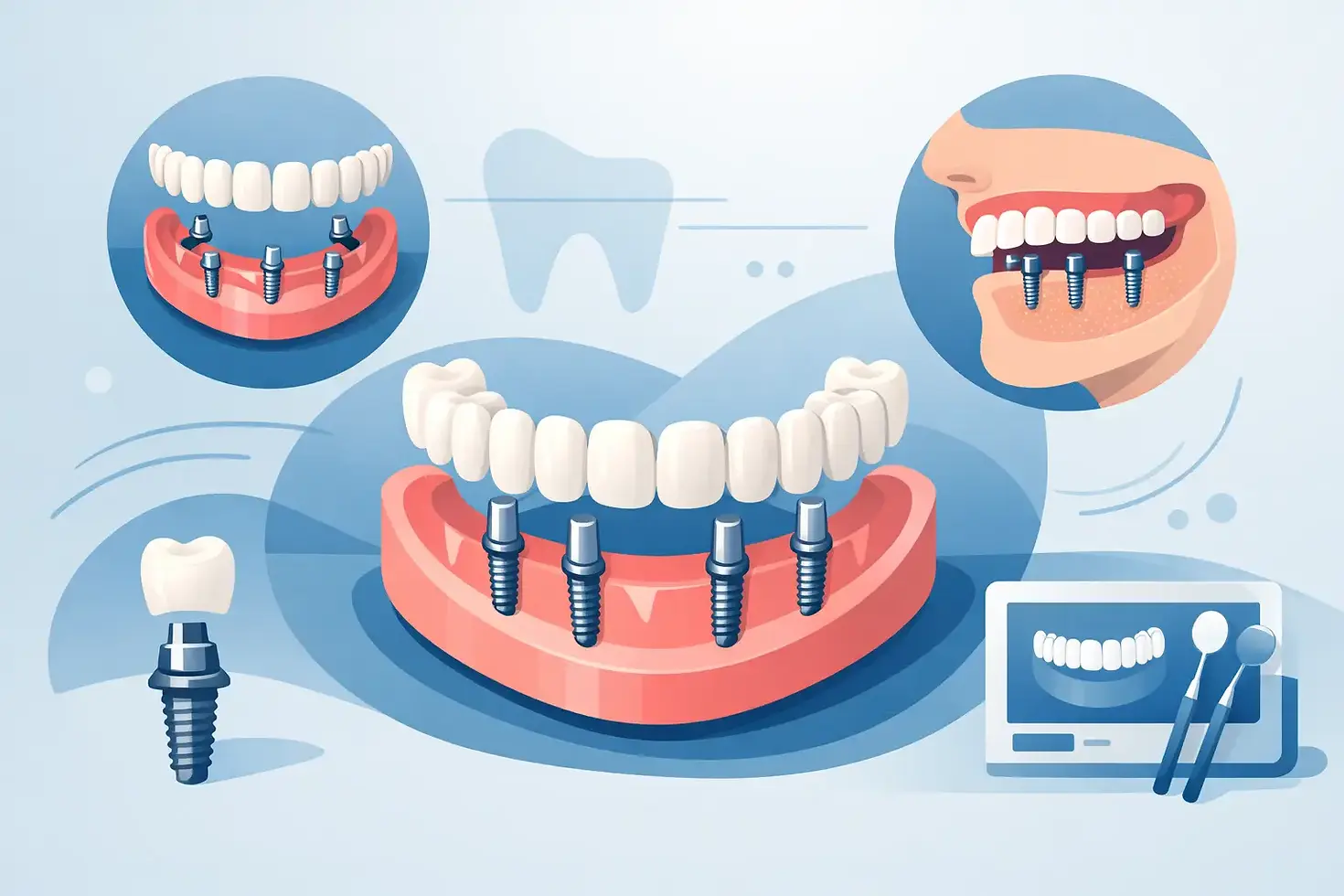
Full arch implants are designed to replace an entire upper arch, lower arch, or both using a small number of strategically placed dental implants that support a fixed set of teeth. Instead of replacing each tooth with a separate implant, this approach rebuilds the whole arch as one carefully planned system. For many patients, that means fewer implants, strong support, and a result that feels much closer to real teeth.
How full arch implants work in simple terms
A full arch implant restoration has two main parts. The first is the implants themselves, which are small titanium posts placed in the jawbone. These act like artificial tooth roots. The second is the arch of teeth that attaches to those implants.
Once the implants are placed, the bone gradually bonds with their surface in a process called osseointegration. That bond is what gives the restoration its long-term stability. After healing, a custom full arch prosthesis is secured to the implants, creating a fixed solution that does not shift the way traditional dentures often do.
Most full arch cases do not require an implant for every missing tooth. In many situations, four to six implants per arch can support a complete set of teeth. The exact number depends on your bone volume, bite forces, anatomy, and treatment goals.
Why this treatment feels different from dentures
Traditional dentures sit on top of the gums. Full arch implants are anchored below the gums into the jawbone. That difference matters every day.
Because the teeth are fixed in place, chewing usually feels more secure. Speech can improve because there is less movement. Many patients also appreciate that they do not need denture adhesive or nightly removal. A well-designed full arch restoration is made to look balanced, support facial structure, and restore function in a way that feels much more natural.
That said, full arch implants are not simply "permanent dentures." They require surgical planning, healthy healing, and precise prosthetic design. The goal is not just to attach teeth to implants. It is to build a stable bite, healthy gum support, and a smile that suits your face.
The planning stage matters as much as the surgery
One of the biggest reasons full arch treatment succeeds is careful planning before anything is placed. This is where modern digital dentistry makes a real difference.
Your dentist begins by evaluating the condition of your remaining teeth, gums, bite, and jawbone. If you still have damaged or failing teeth, the team assesses whether they should be removed as part of the treatment plan. A CBCT 3D scan helps show bone height, bone width, nerve position, sinus anatomy, and areas of weakness that cannot be judged accurately from a standard X-ray alone.
Digital scans and photographs are often used to study your smile line, jaw relationship, and facial support. This allows the final teeth to be planned with both function and appearance in mind. For patients considering a major smile and bite rehabilitation, this planning stage often brings reassurance because it turns a complex treatment into a clear, step-by-step process.
What happens during implant placement
On the day of surgery, any remaining teeth scheduled for removal are extracted first. The implants are then placed into carefully selected positions in the jaw. In many full arch cases, the back implants are angled to make the best use of available bone and reduce the need for more extensive grafting.
This is one reason the treatment can work well even for patients who have experienced some bone loss. By using the denser areas of bone and planning implant positions precisely, the dentist can often create strong support without placing a large number of implants.
If the implants achieve good initial stability, a temporary fixed bridge may be attached on the same day or shortly after. This is often called immediate loading. It allows you to leave with teeth in place rather than spending the healing period without them.
Not every patient is a candidate for immediate loading, though. If bone quality is poor, infection is active, or implant stability is not strong enough, a more gradual healing approach may be safer. This is one of those situations where the best plan depends on biology, not just preference.
The healing phase and why patience matters
Even when temporary teeth are placed quickly, healing still takes time. The implants need several months to integrate with the jawbone. During this period, the temporary teeth help you function and smile confidently, but they also serve another purpose. They protect the surgical sites while the foundation becomes stronger.
You may need to follow a softer diet for a period of time so the implants are not overloaded too early. Good hygiene is also essential. Food and plaque around a full arch restoration can lead to inflammation if cleaning is neglected.
Regular follow-up visits allow your dentist to check healing, adjust the bite if needed, and make sure the temporary restoration is supporting the implants properly. In full arch treatment, small details matter. Tiny bite imbalances can create big forces over time.
How the final teeth are made
Once healing is complete, the temporary bridge is replaced with a final custom restoration. This is where the esthetic and functional refinement really happens.
The final prosthesis is designed based on your healed gums, implant positions, facial proportions, and bite. The shape, shade, tooth length, and gum contour are all considered carefully. A premium full arch result should do more than fill empty space. It should restore a natural smile line, support comfortable chewing, and create a balanced appearance when you speak and laugh.
The materials used can vary. Some restorations combine acrylic with a strong framework, while others use more advanced ceramic-based materials for enhanced esthetics and durability. The best choice depends on bite strength, habits such as clenching, esthetic priorities, and budget.
A good dentist will discuss these trade-offs clearly. Some materials offer beautiful lifelike translucency but may require more careful case selection. Others are practical and durable but may not deliver the same premium esthetic finish. There is no one-size-fits-all answer.
Who is a good candidate?
Many adults with multiple missing, broken, loose, or failing teeth are potential candidates for full arch implants. This treatment is often considered by people who are tired of removable dentures, frustrated by repeated dental breakdown, or facing the loss of most of their remaining teeth.
You do not need to guess on your own whether you qualify. The most important factors are jawbone condition, general oral health, medical history, smoking status, and whether gum disease is under control. Even if you have been told you have bone loss, you may still have options. Modern planning and implant positioning can help many patients who assume they are not candidates.
Still, some cases need added preparation. Gum treatment, extractions, bone grafting, or management of uncontrolled medical conditions may need to happen first. A careful clinic will not rush past these issues just to make treatment sound simple.
How full arch implants work long term
When planned well and maintained properly, full arch implants can provide long-lasting support and excellent daily function. But they are not maintenance-free.
You still need professional reviews and regular cleaning. The prosthesis may need periodic adjustment, and components can wear over time. Just like natural teeth, implants perform best when they are cared for consistently.
Home hygiene is different from cleaning natural teeth, but it is just as important. Patients are usually taught how to clean under the bridge and around the implant areas using specialized tools. This keeps the gums healthy and helps protect the long-term stability of the implants.
At Chong Dental Ipoh Garden, this kind of treatment is approached with detailed digital planning and a comfort-first experience because the best implant result is not only about surgery. It is about building confidence through precision, clarity, and attentive care.
The question behind the procedure
For many patients, the real question is not only how full arch implants work. It is whether they can truly help life feel normal again.
In the right case, they can make a remarkable difference. Eating becomes easier. Speech feels more natural. Smiling stops feeling like something to hide. The process does take planning, healing, and investment, but for many people, the return is measured in daily comfort and restored confidence.
If you are considering full arch implants, the most helpful next step is a thorough evaluation that looks at your bone, bite, goals, and health as a whole. The right treatment should feel personalized, never rushed, and built around both lasting function and the way you want to live.


Comments